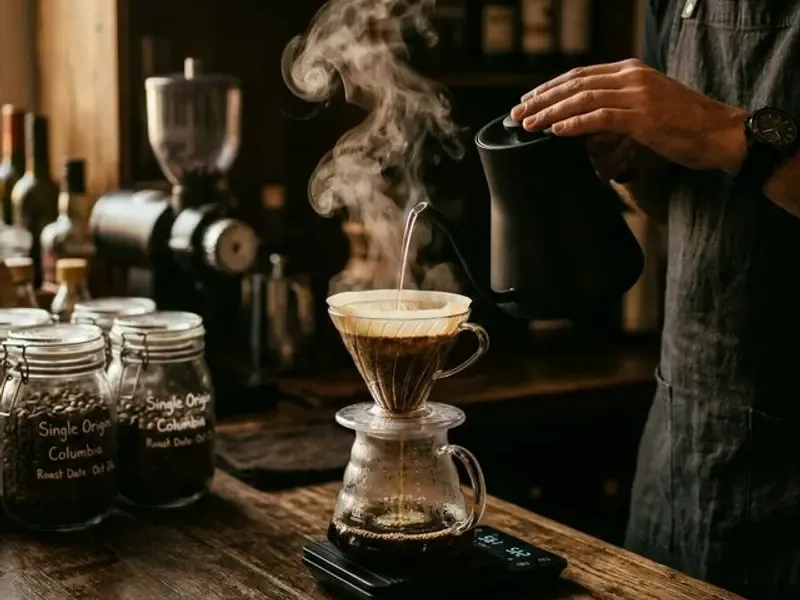
Your First Pour-Over, Done Right: Gear and Method in Full
A beginner's pour-over tutorial: from choosing your gear to every step of the brew, so your very first cup comes out genuinely good. Includes recommended water temperature and brew ratio.
Pour-over is one of the best ways there is to show off what a coffee bean can actually do. All you need is a grinder, a dripper, a gooseneck kettle, filters and a scale, and you can make café-quality pour-over at home. This guide takes you from choosing your gear through the complete brewing method, step by step, so your first attempt lands.
What Gear Do You Need for Pour-Over?
Getting started doesn’t have to be expensive. Here’s the essential list.
The essentials
| Gear | What it does | Suggested budget (NT$) |
|---|---|---|
| Hand grinder | Grinds whole beans | 800–2,000 |
| Cone dripper (V60) | Holds the filter, controls flow rate | 200–500 |
| Paper filters | Strain out the grounds for a clean cup | 100–200 (pack of 100) |
| Gooseneck kettle | Precise control over the pour | 500–1,500 |
| Digital scale | Accurate coffee and water measurements | 300–800 |
Worth adding
- Thermometer (or a kettle with a temperature readout): for controlling water temperature
- Timer: your phone does the job
- Carafe: to collect the finished brew
Your Baseline Recipe
Before you start, commit this beginner-friendly recipe to memory:
| Parameter | Recommended |
|---|---|
| Coffee dose | 15g |
| Total water | 225ml (a 1:15 ratio) |
| Water temperature | 88–92°C |
| Grind size | Medium-fine (like granulated sugar) |
| Total brew time | 2 min 30 sec – 3 min |
Beginner tip: the hotter the water, the stronger the extraction. If the cup tastes too bitter, drop the temperature by 2°C. If it’s too sour or too thin, raise it by 2°C.
The Complete Pour-Over Method
Step 1: Prep
- Heat your water to 92°C (no thermometer? Let boiling water sit for a minute and it lands around 90°C)
- Set the filter in the dripper and rinse it through with hot water (this removes the papery taste and preheats the dripper)
- Discard the rinse water
- Weigh out 15g of beans and grind them medium-fine
- Tip the grounds into the filter and tap the dripper gently to level the bed
Step 2: The Bloom
- Start the timer
- Beginning at the center, pour in small circles until you’ve added roughly 30ml of hot water (twice the weight of the coffee)
- Make sure every ground is wet
- Wait 30–45 seconds. You’ll see the bed swell and bubble — that’s the bloom
Why bloom? Blooming lets the carbon dioxide trapped in the grounds escape, which makes the extraction that follows far more even. The fresher the beans, the more dramatically the bed rises.
Step 3: First Pour
- Once the bloom finishes (around 0:30–0:45), begin the first pour
- Pour in concentric circles from the center outward, at a steady rate
- Build up to about 150ml total
- Keep the stream steady, and never pour onto the edge of the filter
- Pace: this pour should take about 30 seconds
Step 4: Second Pour
- Wait for the water level to drop a little (around 1:15–1:30)
- Pour again in circles from the center outward
- Build up to 225ml total
- This should take about 20–30 seconds
Step 5: Let It Draw Down
- Let the coffee drain through on its own
- Total time should land around 2:30–3:00
- Lift off the dripper and swirl the carafe gently to even out the brew
Done. Pour it out and enjoy your first pour-over ☕
Troubleshooting for Beginners
It came out too bitter
- Drop the water temperature by 2–3°C
- Grind coarser
- Pour faster (shortening the extraction time)
It came out too sour or too weak
- Raise the water temperature by 2–3°C
- Grind finer
- Pour more slowly (lengthening the extraction time)
It tastes muddy or astringent
- Don’t pour onto the edge of the filter — that’s what causes channeling
- Check your water quality (filtered water is best)
- Check that your beans are fresh (within 30 days of the roast date is ideal)
How to Choose Beans for Pour-Over
Pour-over suits light to medium roast single origins best, because those beans have the room to show their origin character in full:
- Ethiopia (light roast): floral, citrus, jasmine (go deeper → inside the Yirgacheffe region)
- Colombia (medium roast): caramel, nuts, chocolate
- Guatemala (medium roast): smoke, cocoa, brown sugar
At Rhine Coffee, our pour-over line uses hand-selected high-altitude single origins, roasted fresh every week. And if you’re not ready to brew at home yet, you can have our baristas’ pour-over delivered instead — see the pour-over menu.
The Real Cost of Brewing at Home
| Gear / consumables | Cost |
|---|---|
| Grinder + dripper + kettle + scale | NT$1,800–4,800 |
| Single-origin beans (2 bags a month) | NT$800–1,600/month (picking good beans is a skill of its own) |
| Filters | NT$100–200/month |
| Up-front investment | NT$2,800+ |
Then add the 10–15 minutes of prep and cleanup every single brew takes, plus the first few bags you’ll burn through as practice while your technique is still finding its footing…
Rhine Coffee’s pour-over line runs NT$110–120, made with carefully sourced single origins and brewed by hand, to order, every day. All you have to do is wait 25 minutes for delivery — and spend that time on anything more rewarding than washing a dripper.
👉 Order a Yirgacheffe pour-over — no gear, no cleanup, no failed brews.
FAQ
Do I really need a dedicated gooseneck kettle?
Strongly recommended. An ordinary kettle gives you no control over how fine your stream is or where it goes, which leads straight to uneven extraction. An entry-level gooseneck costs around NT$500, and it’s the single most worthwhile thing you can buy.
Can I use pre-ground coffee instead of grinding my own?
You can, but the flavor takes a real hit. Once coffee is ground, its aromatic compounds oxidize and disappear fast. Grinding right before you brew is the single most effective step you can take to improve a pour-over.
How do I adjust the brew ratio?
1:15 is a friendly starting point. For something stronger, move to 1:13–1:14; for something lighter, 1:16–1:17. Once you find the ratio you like, lock it in and stick with it.
ORDER NOW
What kind of coffee are you having today?
Single-origin beans, La Marzocco espresso machine, made to order — delivered in 25 min